With an ever-increasing level of change in business environments, whether it be from digitalisation journeys, emerging into a post-COVID world, energy transitions or climate change driven changes, businesses need their people to both upskill and reskill. To meet this challenge, companies will often want or need to seek people with transferable skills. Similarly, workers will want to be able to demonstrate that their skills are transferable and relevant to the new challenges and opportunities that businesses face.
However, having the skills in themselves isn’t necessarily the whole answer. How these skills are applied is arguably a more important factor to consider. This is where competencies come into the conversation.

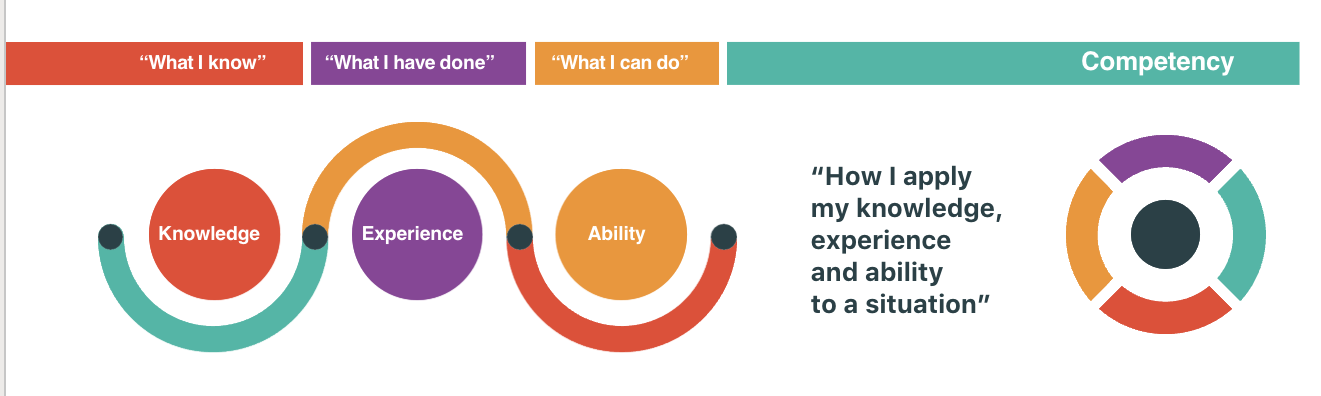
Skills are developed through two broad means. Firstly, the gaining of knowledge through formal education and training routes. Secondly, from experience of applying and using the skills. This latter means guided on-the-job learning where the intent is on increasing knowledge and skill through real-world situations ‘in the field’, but it also includes skills being enhanced and fine-tuned from applying them within a business-as-usual, normal situations.
By contrast, skills deteriorate when they are not practiced over periods of time. Think about trying to speak a language you learnt at school but haven’t used since then... For many people it will be hard to recall what they learnt and certainly harder to apply it as they start attempting to re-use the language.
For businesses, especially those where deploying Suitably Qualified and Experienced Personnel (SQEP) is essential, this can present challenges… How does a company manage its process to assure competency levels? How can a company have confidence that the people carrying out their roles have the right competencies, at the right levels, to ensure customers are satisfied with performance and outcomes? How do you know that your staff are strengthening their skillset and using this competently in their roles?
Traditionally, HR functions have focused competency processes on defining behavioural elements, but competency frameworks now often include technical competencies[1]. In many industries that need to deploy workers that are SQEP, managing technical competencies has been a need for a long time. As the CIPD highlights, recently there has been a larger focus on including technical competencies within company competency frameworks regardless of industry. This is in response to the ever-deepening influence of technology on businesses generally.
As competency is how an individual applies their training, knowledge and experience, when that individual is working in a novel situation, they have the opportunity to enhance or extend their level of skill, which is to say that they have the opportunity to enhance their competency.
This is more than a company will typically be able to record in a Learning Management System (LMS) or even a Performance Management platform, as these typically are not designed to handle situation specific use of knowledge.
Similarly, skills databases are typically designed to capture skills by experience: An individual has done X, so is recorded as having skill in X.
Competency is dependent upon the situation, and as business environments change, individual workers continue to face novel situations at work, using their competencies to successfully undertake their roles (Capaldo, Iandoli & Zollo[2] call these emerging competencies). This makes your company’s competency framework and its application unique to your company. Although your company’s competency framework may have standard building blocks, the devil is in the detail, as the saying goes.
Having a flexible competency management & assurance tool that enables competencies to be appropriately recorded; assessed in a situation-specific manner will enable more robust management decision making around those key questions mentioned earlier:
- How does a company manage its process to assure competency levels?
- How can a company have confidence that the people carrying out their roles have the right competencies, at the right levels, to ensure customers are satisfied with performance and outcomes?
- How do you know that your staff are strengthening their skillset and using this competently in their roles?
If you would like to discuss how SQEPtech can support your business in meeting these challenges and opportunities, please get in touch (contact@sqeptech.com). We’d love to speak with you.
[1] CIPD. (2020). Competence and competency frameworks. www.cipd.co.uk
[2] Capaldo, Iandoli & Zollo. (2006). A situational perspective to competency management. Human Resources Management. 45(3).
.jpg)

.png)